1.9 Sustainable Promotion Framework
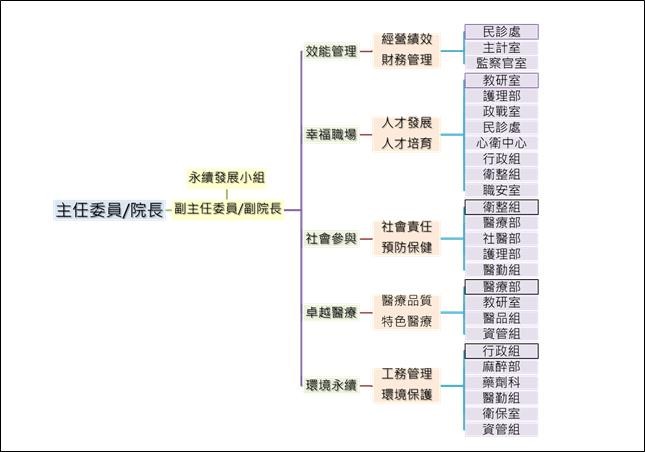
To effectively promote the institutionalization and strategic implementation of sustainable governance, Taichung General Hospital of the National Defense Medical Center officially established the “Sustainable Development Committee” in 2025. This committee serves as the highest guiding and decision-making coordination body for all sustainable development affairs within the hospital, overseeing policy planning, execution, and performance monitoring across the three key dimensions of Environment (E), Society (S), and Governance (G). The creation of this organizational structure marks the hospital’s transition from a decentralized approach to a more institutionalized, hierarchical, and systematic governance model for sustainability management, further enhancing the integration of sustainable development with medical operational strategies.
Regarding the organizational governance structure
The Sustainable Development Committee is chaired by the hospital director, who provides the highest-level guidance and approval for overall sustainability policies. The deputy director, deputy director of teaching, and director of political warfare jointly serve as vice chairpersons, forming a core leadership group that assists in cross-departmental resource integration and strategic coordination. Committee members serve one-year terms, which may be renewed, with adjustments made according to changes in their primary roles. By involving senior executives directly in sustainability governance decisions, the hospital ensures alignment between sustainable development goals and its core medical mission, while enhancing policy implementation effectiveness and organizational mobilization capacity.
Regarding the structure of functional implementation
Under the Sustainable Development Committee, five functional subgroups have been established: the Performance Management Group, Happy Workplace Group, Social Participation Group, Excellence in Medical Care Group, and Environmental Sustainability Group. These correspond to the hospital’s five main operational pillars for sustainable development. Each group is led by a deputy director or a first-level supervisor relevant to the respective area and is responsible for strategic planning, execution, and performance tracking within their domain. Their activities are managed and reviewed according to annual goals and key performance indicators (KPIs).
Specifically, the “Performance Management Group” focuses on resource allocation efficiency, process optimization, and management system refinement to enhance overall operational effectiveness. The “Happy Workplace Group” concentrates on employee welfare, workplace safety, talent development, and organizational culture building to create a friendly and supportive work environment. The “Social Participation Group” promotes community health advancement, rural care, public welfare services, and diversity and inclusion to strengthen the hospital’s social impact. The “Excellence in Medical Care Group” is dedicated to improving medical quality, patient safety, and clinical service enhancement. Finally, the “Environmental Sustainability Group” is responsible for energy management, carbon emission reduction, waste management, and promoting green healthcare to gradually reduce the environmental impact of operations.
To enhance overall execution and horizontal integration capabilities, the hospital has established a Sustainable Development Task Force as the committee’s executive and coordinating unit. This task force is responsible for promoting sustainability initiatives within the hospital, consolidating data, and tracking performance. It regularly reviews progress on major issues and goal achievement. Additionally, it coordinates efforts across subgroups and integrates information to ensure that sustainability measures are effectively implemented and that a consistent management framework is maintained.
Regarding the operation mechanisms of meetings
Starting in 2025, a regular governance meeting system will be established. Each functional subgroup will hold quarterly sustainable development meetings, chaired by the group leader, to review and discuss execution results, key performance indicator achievements, and major issues. These discussions will cover short-, medium-, and long-term strategic adjustments, cross-departmental collaboration, and resource allocation optimization, resulting in concrete resolutions and action plans aimed at continuously improving the effectiveness of sustainable governance.
Decisions made in each meeting are submitted to the hospital director for approval according to established procedures to ensure policy consistency and decision quality. The Sustainable Development Task Force is responsible for follow-up, execution, and effectiveness management, forming a PDCA (Plan-Do-Check-Act) cycle governance mechanism of “decision—execution—tracking—feedback.” This approach enables systematic management of sustainability progress and timely responses to internal and external environmental changes.
Additionally, the hospital has established an annual “Sustainable Development Conference,” personally chaired by the hospital director, to present the year’s sustainability goals, policy directions, and implementation results to the entire hospital. This conference facilitates cross-unit communication and experience sharing, fostering organizational consensus and strengthening the internalization of a sustainability culture. Furthermore, this mechanism serves as a key annual governance platform, enhancing organizational cohesion and consistency in promoting sustainability.
In summary
The hospital’s sustainability promotion framework has gradually developed into a comprehensive system characterized by strong governance leadership, specialized functional divisions, and execution tracking mechanisms that balance strategic decision-making with grassroots implementation needs. Through a committee system, subdivided labor groups, integration of execution units, and regular meetings, the hospital continuously improves coordination, execution capabilities, and the measurability of sustainable governance.
Looking ahead, the hospital will continue to optimize its sustainability governance framework, strengthen data-driven management and performance tracking mechanisms, and deepen cross-departmental integration and external stakeholder engagement. This approach will ensure that sustainable development becomes not only an integral part of governance mechanisms but also internalized as a core value of medical services and organizational culture. These efforts will continuously drive the medical system toward long-term goals of greater resilience, efficiency, and sustainable development capacity.
Organizational Structure of the Sustainability Development Committee of the Taichung General Hospital, National Army
| Organizational Structure of the Sustainable Development Committee | |||
| Group | Title/Department | Position | Identity |
|---|---|---|---|
|
Guidance Team |
Director | Major General Dean | Physician |
| Deputy Director | Colonel Deputy Dean | Physician | |
| Deputy Director | Deputy Dean of Teaching | Physician | |
| Deputy Director | Colonel Political Warfare Director | Political Warfare Supervisor | |
| Performance Management Team | Public Medical Services Department | Colonel Director | Physician |
| Happy Workplace Team | Hospital Headquarters | Associate Dean of Education | Physician |
| Social Participation Group | Main Hospital | Deputy Colonel Director | Physician |
| Excellence in Medical Care Group | Medical Department | Colonel Director | Physician |
| Environmental Sustainability Team | Medical Planning and Management Office | Senior Colonel Director | Health Administration Supervisor |
Organizational Structure of the Court’s Sustainable Development Committee