
3.3 Long-term care support
Facing the challenges of an aging society, the rising prevalence of chronic diseases, and the growing demand for long-term care, Taichung Armed Forces General Hospital has incorporated long-term care services into its core sustainable development strategies. By integrating medical expertise, nursing care, rehabilitation services, and community resources, the hospital has established a patient-centered, integrated care model to enhance the continuity, accessibility, and quality of medical services, helping elderly and disabled individuals receive appropriate and comprehensive health support.
Continuously Advancing Home Medical Care and Long-Term Care Services
The hospital continues to promote home medical care and long-term care services, delivered by an interdisciplinary team that provides home visits, medication assessments, health management, and care consultations. These services assist patients with mobility challenges, disabilities, or dementia in receiving medical care within familiar environments, thereby reducing barriers to access and alleviating caregiving burdens. In 2025, a total of 130 cases were served, with a cumulative 1,689 service visits. This approach effectively minimized the inconvenience of traveling to medical facilities, decreased emergency visits and rehospitalization risks, and enhanced the quality of care and efficiency in medical resource utilization.
Regarding Institutional Care
The hospital-affiliated nursing home primarily admits residents with high medical care needs, including those requiring regular dialysis, frequent medical visits, individuals living alone without caregiving support, and elderly persons with significant disabilities. The average number of monthly medical visits per resident (excluding chronic prescription refills) reached 180, indicating that many residents have complex medical care requirements.
The nursing home has 49 beds, with an average occupancy rate of 73.41% in 2025. Notably, there is no age limit for admission; residents range in age from 3 to 95 years, with an average age of 80.5 years. This creates a cross-generational, inclusive care environment that exemplifies diversity, inclusiveness, and holistic care.
2025 Operational Status of the Hospital’s Nursing Home
| Item | Annual Statistics |
|---|---|
| Total bed days | 17,885 |
| Total person days | 12,471 |
| Inpatient reserved person days | 659 |
| Total person days + inpatient reserved person days | 13,130 |
| Average bed occupancy rate | 73.41% |
To improve the quality and effectiveness of long-term care services, our hospital conducted case analyses and care needs assessments focusing on the care processes of residents. We identified common care challenges among elderly residents, including care discontinuity, feelings of loneliness, attachment needs, functional decline, and loss of self-worth. The analysis results indicate that long-term care services, beyond addressing basic medical and daily care needs, must also prioritize psychological support, social connections, and the fulfillment of life’s value.
The case analysis results from our hospital are as follows:
| Case | Core Issues | Professional Reflection |
|---|---|---|
| Case 1: Functional Decline After Returning Home | Care Gaps and Feelings of Loneliness | Home long-term care services can provide basic support but cannot fully compensate for the safety and companionship needs caused by the absence of family members. The risk of falls often results from the interaction between physical frailty and environmental hazards. |
| Case Two: The Determined Sense of Settlement | Redefining the Concept of Home | When elderly individuals choose to sell their property and move into an institution, it signifies that they have established a psychological identification of the institution as their home. It also implies that the institution must take on the important responsibilities of daily care and end-of-life support. |
| Case 3: Separation Anxiety and Attachment | Establishing Psychological Safety | Elderly residents have a high need for companionship and a sense of security. Providing around-the-clock support and immediate care in the facility helps reduce feelings of loneliness and anxiety. |
Maslow’s Hierarchy of Needs Theory
To address the diverse needs of residents, our institution bases its approach on Maslow’s hierarchy of needs theory, beginning with physiological needs, followed by safety, social, esteem, and self-actualization needs. We have progressively developed care models—”Enable,” “Reablement,” and “Empowerment”—to assist residents in gradually transitioning from being cared for to living independently, thereby enhancing their quality of life and sense of self-worth.
Michael Porter’s Value Chain Management Concept
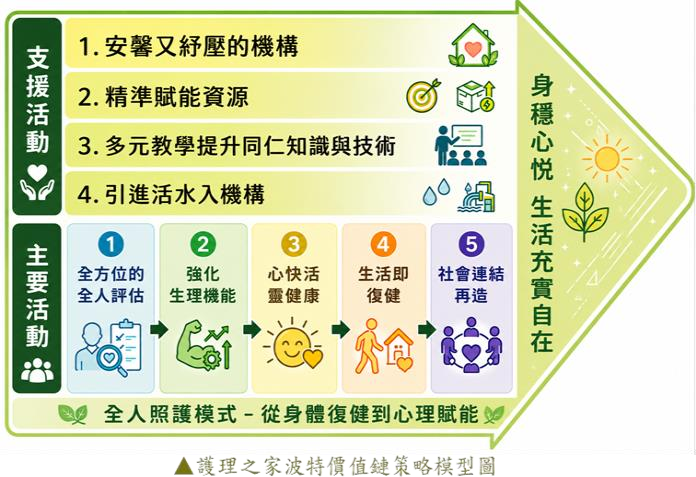 At the same time, our institution has adopted Michael Porter’s value chain management concept to establish a strategic framework for developing nursing home services, which is divided into two main categories: support activities and primary activities.
Support activities include:
- Establishing a peaceful and stress-relieving care environment.
- Introducing targeted reablement resources
- Providing diverse educational training to enhance staff members’ professional knowledge and skills.
- Incorporating external resources and establishing cross-domain collaboration mechanisms
Primary activities include:
- Comprehensive, holistic assessments
- Strengthening physical functions and reablement training
- Promoting mental health and offering emotional support
- Implementing a care model in which daily life itself serves as rehabilitation.
- Facilitating social participation and rebuilding interpersonal relationships
Through the strategies outlined above, our institution helps residents gradually transition from “being cared for” to “self-care.” This process extends from physical rehabilitation to psychological empowerment and social engagement, ultimately achieving the care goal of a “stable body, joyful mind, and fulfilling, comfortable life.”
Holistic Development Care Pyramid
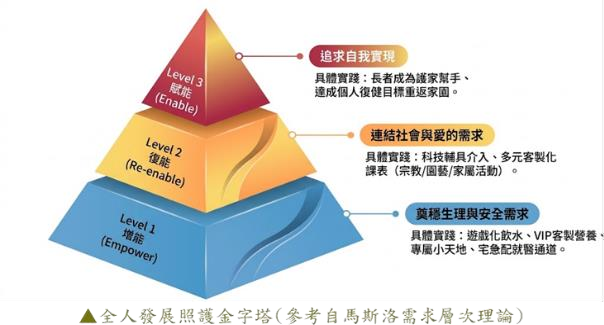 Additionally, our institution has developed a “Holistic Development Care Pyramid” based on Maslow’s hierarchy of needs theory, designing specific care measures tailored to each level of need.
Securing physiological and safety needs.
- Gamified Water Intake Management
- VIP Customized Nutritional Care
- Personalized living space planning
- Green channel for urgent medical appointments and services.
Connecting Social and Romantic Needs
- Introduction to Assistive Technology
- Diverse, customized activity programs
- Religious care activities
- Horticultural Therapy Courses
- Family Participation Activities
Pursuing self-actualization needs.
- Encouraging residents to actively participate in institutional services.
- Assuming helper roles within the care home
- Assisting in the achievement of personal rehabilitation goals
- Supporting the return to family and community life
Holistic Care Model
Through a holistic care model, our institution focuses not only on residents’ physical health but also emphasizes psychological support, social engagement, and the fulfillment of life’s value. We are progressively developing a long-term care service system that integrates medical care, daily living support, and social connections.
Looking ahead, our institution will continue to expand home medical care, emergency home care, and joint care service models within nursing homes. We will strengthen cooperation with long-term care institutions, community centers, and local resources, progressively building a community-based integrated care network. Simultaneously, through performance indicator management and service quality monitoring mechanisms, we will continuously optimize resource allocation and care effectiveness to meet the growing long-term care demands of an aging society, creating a care system that integrates medical quality, social value, and sustainable resilience.