
4.4 Medical research
As a regional teaching hospital that integrates medical care, education, and research, our institution consistently prioritizes research and development as a vital foundation for enhancing medical quality, fostering clinical innovation, and strengthening the organization’s sustainable competitiveness. Through a robust research project management system and diverse resource investment mechanisms, we actively encourage physicians, nurses, and other healthcare professionals to engage in academic research and innovative development. This approach transforms clinical practice needs into tangible research outcomes, thereby further improving the quality of medical care and patient welfare.
Research Project Application and Review Mechanism
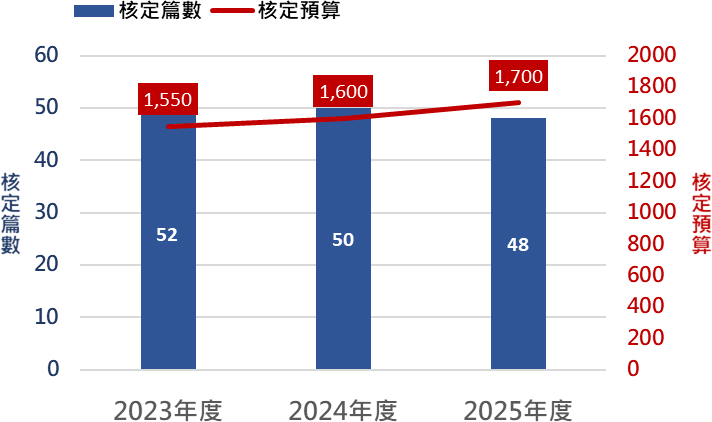
Our hospital has established a comprehensive application and review mechanism for research projects. In addition to providing regular research funding, we offer special project resources focused on key areas such as medical quality improvement, management optimization, clinical care innovation, and smart medical development to support our colleagues in continuously engaging in research. Over the past three years, both the budget for internal research project funding and the number of approved projects have shown steady growth. In 2025 alone, 48 research projects were approved, with total funding exceeding NT$17 million, demonstrating our hospital’s commitment and achievements in enhancing research and development capacity.
In addition to continuously investing internal research resources, our hospital actively encourages colleagues to seek external research funding from key organizations such as the Ministry of National Defense Military Medical Bureau, the National Science and Technology Council, the National Health Research Institutes, and the Ministry of Health and Welfare. This strategy aims to expand the scope of research and enhance both the academic impact and practical application of research outcomes. Notably, within the National Defense Medical Research Program under the Ministry of National Defense Military Medical Bureau, the number of approved projects from our hospital has demonstrated a consistent year-on-year increase in recent years, reflecting the ongoing strengthening of our internal research capabilities.
Furthermore, in 2024 and 2025, our hospital successfully secured three grants from the National Science and Technology Council for general and new investigator research projects. This achievement demonstrates that our research outcomes and project quality have been highly recognized by national-level research institutions.
The number of approved research projects and the corresponding budgets for our hospital over the past three years are as follows:
In recent years, our institute has received research project funding from the National Science Council as follows:
| Funding Agency | Funding Year | Project Type | Research Topic | Executing Department |
|---|---|---|---|---|
| National Science Council | 2024 | General Category | Investigation of the Mechanism by Which GLP-1 Signaling Inhibits Metabolic Dysfunction-Associated Fatty Liver Disease Through Regulation of Epithelial-Mesenchymal Transition | Department of Family Medicine |
| National Science Council | 2025 | General Category | Investigation of the Molecular Mechanism by which GLP-1 Receptor Agonists and Adiponectin Alleviate MASLD through the AMPK Pathway | Department of Family Medicine |
| National Science Council | 2025 | New Personnel | Analysis of Multimorbidity Trajectories among Middle-aged and Elderly in Taiwan and the United States and Their Association with Health Prognosis: A Cross-cultural Hierarchical Linear Modeling Study | Department of Family Medicine |
Academic Publication Achievements and Research Impact
As research projects continue to advance, the academic influence of our institute has steadily increased. In recent years, research findings from physicians and various medical professionals have been increasingly accepted and published in SCI-indexed international journals, demonstrating the solid foundation our institute has established in clinical research, translational medicine, and evidence-based healthcare.
Statistics from the past five years show that our institute has published a total of 129 papers in SCI journals, 24 papers in other journals, and delivered 259 presentations at conferences, amounting to a total of 420 publications. Among these, 10 research papers were published in high-impact SCI international journals with an Impact Factor (IF) greater than 5, demonstrating that our research outcomes possess not only academic value but also international visibility and professional influence.
Summary of our institute’s academic publications from the past five years:
| Year of Publication | SCI Journal | Journal | Oral Presentation | Poster | Total (Number of Items) |
|---|---|---|---|---|---|
| 2021 | 27 | 3 | 5 | 30 | 66 |
| 2022 | 35 | 7 | 8 | 41 | 96 |
| 2023 | 18 | 5 | 15 | 34 | 73 |
| 2024 | 27 | 6 | 14 | 53 | 100 |
| 2025 | 22 | 3 | 9 | 50 | 85 |
| 總計 | 129 | 24 | 51 | 208 | 420 |
The following are representative high-impact papers from our institute in recent years:
| Year | Department | Name | Paper Title | Journal Name | Academic Field | Impact Factor (IF) |
|---|---|---|---|---|---|---|
| 2022 | Family Medicine | Liao Junzheng | Testosterone Level Reduction Increases the 10-Year Risk of Cardiovascular Diseases: A Retrospective Cohort Study in a Taiwanese Young Male Population |
Frontiers in Cardiovascular Medicine | Clinical Medicine | 6.05 |
| 2022 | Orthopedics | Lai Renjie | Kefir peptides promote osteogenic differentiation to enhance bone fracture healing in rats | Life Sciences | Basic Medical Science | 6.78 |
| 2023 | Radiology Department | Pan Longfa | Risk of New-onset Stroke in Patients with Type 2 Diabetes with Chronic Kidney Disease on Sodium-glucose Co-transporter-2 Inhibitor Users |
Translational Stroke Research | Clinical Medicine | 6.9 |
| 2024 | Dental Department | Qiu Guozhou | Long-term analysis of humoral responses and spike-specific T cell memory to omicron variants after different COVID-19 vaccine regimens |
Frontiers in Immunology | Clinical Medicine | 7.3 |
Promoting a Cross-Disciplinary Research Culture
Our institute actively promotes a research culture that spans multiple professions and disciplines, encouraging healthcare professionals from various fields to collaborate in academic research and the publication of their findings. In recent years, the publication rates among physicians, dentists, and traditional Chinese medicine practitioners have consistently remained high, at approximately 50%, demonstrating stable and mature research capabilities.
Colleagues in allied health professions also demonstrate a high level of academic engagement. Over the past five years, nurses have collectively produced 54 research outputs, including 9 journal articles and 45 posters. Medical laboratory scientists have completed 23 poster presentations, while radiologists have published 24 research outputs, comprising 10 journal articles and 14 posters. Nutritionists have presented 7 academic posters. Additionally, professionals such as psychologists, physical therapists, specialist nurses, occupational therapists, and pharmacists continue to contribute to research efforts, collectively fostering an academic research and development environment grounded in interdisciplinary collaboration.
Industry-Academia Collaboration and the Translation of Research Outcomes
To facilitate the translation of research outcomes and broaden the benefits of academic collaboration, our institute actively establishes long-term partnerships with leading universities and colleges in Taiwan. Through research cooperation, teaching exchanges, and talent development, we strengthen the industry-academia collaboration network.
As of 2025, our institute has established cooperative relationships with several major universities in central Taiwan, completing a total of 47 collaborative research projects and jointly publishing 13 SCI journal articles and 17 academic posters. The specific achievements are as follows:
- During the collaboration period with National Chung Hsing University (January 1, 2023 – December 31, 2027), a total of five research projects have been completed, including two SCI journal articles and one academic poster.
- During the collaboration period with Tunghai University (January 1, 2023 – December 31, 2027), a total of six research projects have been completed, including two academic posters.
- Cooperation with Central Taiwan University of Science and Technology (January 1, 2023 – December 31, 2026) has been highly productive, with 36 research collaborations completed, resulting in 11 SCI journal articles and 14 academic posters.
- Joint research projects with National Taichung University of Science and Technology (January 1, 2023 – December 31, 2027) continue to enhance overall R&D output and foster academic exchange benefits.
2025 Industry-Academia Collaboration Outcome Statistics for Our Institute:
| Partner Schools | Collaboration Period | Number of Collaborative Research Papers | Publications in SCI Journals | Academic Poster Presentations | Description of Collaborative Achievements |
|---|---|---|---|---|---|
| National Chung Hsing University | 2025.1.1- 2027.12.31 |
5 articles | 2 articles | 1 article | Jointly promote research projects to strengthen clinical research and academic collaboration capabilities |
| Tunghai University | 2025.1.1- 2027.12.31 |
6 articles | 0 article | 2 articles | Deepen teaching and research collaboration and industry-academia connections to promote interdisciplinary research exchange. |
| Central Taiwan University of Science and Technology | 2025.1.1- 2026.12.31 |
36 articles | 11 articles | 14 articles | The most fruitful results come from cross-institutional cooperation, with outstanding research achievements and academic output. |
| National Taichung University of Science and Technology | 2025.1.1- 2027.12.31 |
Ongoing | Ongoing | Ongoing | Jointly promoting research projects to continuously enhance overall research and development capacity. |
| Total | 47 articles | 13 articles | 17 articles |
Cultivating Teaching Talent and Developing Academic Networks
In addition to emphasizing research and development, our institute actively cultivates advanced teaching and research talents and continuously strengthens the functions of the teaching hospital. In 2025, five colleagues successfully achieved promotion to assistant professor. Currently, the total number of appointed faculty members has reached 62.
In terms of teaching collaboration, the National Defense Medical Center and Central Taiwan University of Science and Technology are the primary partners. The National Defense Medical Center has 16 lecturers, 12 assistant professors, and 2 associate professors, while Central Taiwan University of Science and Technology has 15 lecturers, 4 assistant professors, 1 associate professor, and 1 professor. Together, these two institutions comprise more than 80% of the institute’s teaching faculty, making them key pillars for the institute’s teaching and research development.
Additionally, the institute maintains collaborative teaching relationships with eight other schools and colleges: Chung Shan Medical University, Nanhua University, National Chin-Yi University of Technology, Chaoyang University of Technology, Fooyin University, Ling Tung University, Jen-Teh Junior College of Medicine, Nursing and Management, and Kao-Mei College of Nursing. This ongoing effort continues to expand the cross-institutional collaboration network.
According to the institute’s 2025 statistics on adjunct university faculty:
| Category | Number of People |
|---|---|
| National Defense Medical Center | 32 |
| Other Institutions | 10 |
| Total Number of People | 42 |
Our institute has actively pursued research funding from the National Science and Technology Council. Over the past two years, three research projects have been approved, with total funding amounting to 3,577,000 NTD. These projects address critical medical issues, including the molecular mechanisms underlying metabolic dysfunction-associated steatotic liver disease (MASLD) and the analysis of multimorbidity trajectories and health prognoses in middle-aged and elderly populations. The research combines clinical application value with academic rigor. The outcomes not only advance disease prevention and treatment strategies but also highlight our institute’s research and development capabilities and academic competitiveness in basic medicine, clinical medicine, and public health. By continuously investing in research resources and promoting innovative medical studies, our institute will further integrate medical care, education, and research, thereby enhancing healthcare quality and fostering sustainable development.
Statistics on the Implementation of National Science Council Research Projects
| Funding Agency | Funding Year | Project Type | Project Title | Principal Investigator | Funding Budget |
|---|---|---|---|---|---|
| National Science and Technology Council | Year 113 | General Category | Investigation of the Mechanism by Which GLP-1 Signaling Inhibits Metabolic Dysfunction-Associated Fatty Liver Disease through Regulation of Epithelial-Mesenchymal Transition Mechanisms | Director: Liao Junzheng | 1,137 thousand NTD |
| National Science and Technology Council | Year 114 | General Category | Investigation of the Molecular Mechanism by Which GLP-1 Receptor Agonists and Adiponectin Alleviate MASLD via the AMPK Pathway | Director: Liao Junzheng | 1,360 thousand NTD |
| National Science and Technology Council | Year 114 | New Staff | Analysis of Multimorbidity Trajectories Among Middle-aged and Older Adults in Taiwan and the United States and Their Association with Health Outcomes: A Cross-cultural Hierarchical Linear Modeling Study | Director Xin-En He | 1,080 thousand NTD |
Overall, our hospital has gradually established a medical research environment that integrates clinical expertise, research capabilities, and sustainable development potential. This has been achieved through a comprehensive research funding system, active acquisition of external research resources, encouragement of interdisciplinary academic research and publication, and continuous enhancement of industry-academia collaboration and talent development mechanisms. Moving forward, our hospital will continue to integrate clinical, teaching, and research resources; strengthen interdisciplinary collaboration; and promote the translation and application of research outcomes. These efforts aim to enhance overall R&D capacity and academic influence, drive improvements in medical service quality through innovation, and realize a long-term vision that simultaneously advances medical care, academic research, and sustainable development.