2.1 Hospital Governance and Sustainable Management
Supervision and Governance by the Military Medical Bureau
As a vital component of the military medical system, Taichung Armed Forces General Hospital upholds a strong sense of responsibility, dedicating itself to delivering high-quality medical services and ensuring the sustainable development of the healthcare system. Throughout this process, the hospital’s governance structure and operational methods strictly adhere to established regulations and standards under the guidance and supervision of the Military Medical Bureau, ensuring transparency, fairness, and efficiency in its operations.
The Military Medical Bureau, as the highest authority within the military medical system, is responsible for supervising and managing the overall operations of the hospital. It ensures that the hospital complies with military medical policies as well as relevant laws and regulations. The Bureau not only provides strategic guidance to the hospital but also oversees the implementation of various hospital activities, ensuring the proper use of medical resources, the quality of medical services, and the maintenance of medical safety.
In terms of governance, the Military Medical Bureau regularly conducts internal management supervision, research and development control assessments, and advisory visits to various military hospitals. It adjusts the hospitals’ operational directions and strategies based on the latest policy requirements and regulations. Through transparent communication mechanisms and rigorous supervision, these hospitals can continuously improve the quality of medical services, promote optimal resource utilization, and provide more sustainable medical care for military personnel and the public.
Furthermore, the hospital’s governance structure includes dedicated risk management and internal control mechanisms to ensure that all medical and administrative activities comply with the Military Medical Bureau’s guiding principles and sustainability requirements. The Bureau regularly reviews the hospital’s operational status and provides feedback on performance, promoting continuous optimization of services and management models. Through the professional supervision and coordination of the Military Medical Bureau, Taichung Armed Forces General Hospital ensures that its sustainable development goals are closely aligned with the mission of the military medical system, continuously enhancing the transparency and efficiency of hospital governance to achieve higher quality and greater social benefits in future medical services.
Our hospital’s services are located in central Taiwan and are overseen and managed by the Military Medical Bureau of the Ministry of National Defense. The hospital director is appointed by the Military Medical Bureau based on merit, selected from all military medical institutions nationwide. The director of the Civilian Clinic is elected by a member of the hospital’s affiliated civilian medical service management committee, chosen from among the medical supervisors. As a military hospital, the governance team and supervisory group include, as executive members, the hospital director, deputy director, director of the Zhongqing branch, director of the medical department, director of the planning office, director of the civilian clinic, director of the nursing department, and director of the accounting office. The supervisory members also include the political warfare director and the inspector. Additionally, three executive members and five supervisory members are elected by the management committee to form the joint membership of the civilian clinic’s supervisory and executive group. All committee members serve without remuneration.
Members of Our Hospital’s Governance Team
| Unit | Position Level | Name | Education | Experience |
|---|---|---|---|---|
| Main Hospital Headquarters | Major General, Hospital Director | Shi Yulong | 1. Postdoctoral Research at Yale University School of Medicine, USA 2. Doctoral Program, Institute of Medical Science, National Defense Medical Center 3. Class of 1995, Department of Medicine, National Defense Medical Center |
1. Director, Military Medical Office, Army Logistics Command 2. Director, Health Care Division, Military Medical Bureau, Ministry of National Defense 3. Director, Penghu Branch, Tri-Service General Hospital |
| Main Hospital | Deputy Director (Colonel) | Guo Jiawen | 1. Ph.D. Program, Institute of Life Sciences, National Chung Hsing University 2. Class of 1998, Department of Medicine, National Defense Medical Center |
1. Director, Zhongqing Branch, Taichung Armed Forces General Hospital 2. Director, Nephrology Department, Taichung Armed Forces General Hospital |
| Main Campus | Associate Dean of Teaching | Li Jianda | 1. PhD Program, Institute of Life Sciences, National Chung Hsing University 2. Class of 1988, Department of Medicine, National Defense Medical Center |
1. Deputy Director, Taichung Armed Forces General Hospital 2. Director of Medical Department, Taichung Armed Forces General Hospital |
| Main Hospital Headquarters | Colonel, Political Warfare Director | Xu Ruixian | 1. Political Warfare College, Class of Year 85 (1996) 2. Political Warfare College, Liberation Army Research Institute, Class of Year 102 (2013) 3. National Defense University, War College, Class of Year 110 (2021) |
1. Deputy Director of Political Warfare, Headquarters of the 8th Army Corps, Army 2. Director of Political Warfare, Chung Cheng National Defense Cadet School 3. Deputy Director of Political Warfare, Penghu Defense Command, Army |
| Zhongqing Branch Hospital | Branch Director | Yue Dezheng | 1. Department of Medicine, National Defense Medical Center, Class of 2000 2. Department of Food Science and Biotechnology, National Chung Hsing University, Master’s Class of 2014 3. Institute of Biomedical Sciences, China Medical University, PhD Class of 2020 |
1. Director, Outpatient Department, Taichung Armed Forces General Hospital 2. Director, Department of Surgery, Taichung Armed Forces General Hospital |
| Medical Department | Colonel Director | Wang Shouzheng | 1. National Defense Medical Center, Department of Medicine, Class of 2000 2. Central Taiwan University of Science and Technology, Department of Radiological Technology, PhD Class of 2016 |
1. Deputy Director, Medical Planning Division, Military Medical Bureau, Ministry of National Defense 2. Director, Zhongqing Branch, Taichung Armed Forces General Hospital 3. Director, Outpatient and Emergency Department, Taichung Armed Forces General Hospital |
| Civil Clinic | Colonel Director | Yang Denghe | 1. National Defense Medical Center, Department of Medicine, Class of 2000 2. Chung Shan Medical University, Graduate Institute of Medical Sciences, PhD Class of 2014 |
1. Director, Department of Internal Medicine, Taichung Armed Forces General Hospital 2. Director, Department of Laboratory Medicine, Taichung Armed Forces General Hospital |
| Planning Office | Colonel Director | Wu Piyu | 1. Department of Public Health, National Defense Medical Center, Class of 2000 2. Doctoral Program in Public Health, National Taiwan University, Class of 2022 |
1. Section Chief, Health Care Division, Military Medical Bureau 2. Specialist Commissioner, Medical Planning Division, Military Medical Bureau 3. Inspector, Medical Management Division, Military Medical Bureau |
| Nursing Department | Colonel Director | Chen Yahong | 1. Department of Nursing, National Defense Medical Center, Class of 1996 2. Master’s in Business Administration, Chaoyang University of Technology, Class of 2012 |
1. Deputy Director, Nursing Department, Taichung Armed Forces General Hospital 2. Chief Supervisor, Nursing Department, Taichung Armed Forces General Hospital |
| Accounting Office | Lieutenant Colonel Director | Huang Guozheng | 1. Department of Accounting, National Defense Management College, Class of 2004 2. Master of Financial Management, National Defense Management College, Class of 2011 |
1. Lieutenant Colonel Auditor, Military Medical Bureau, Ministry of National Defense
|
The authorized number of staff for all categories in this institution
| Physicians (including dentists) | Nursing staff | Medical technicians | Administrative staff | Total | |
|---|---|---|---|---|---|
| Authorized Number | 183 | 400 | 171 | 265 | 1019 |
| Current Staff Number | 151 | 356 | 150 | 229 | 886 |
| Authorized-to-Current Ratio | 82.5% | 89% | 87.7% | 86.4% | 86.9% |
Amid the global trends of ongoing digital transformation, sustainable development, and resilient governance in healthcare systems, Taichung Armed Forces General Hospital—operating under the management system of the Military Medical Bureau of the Ministry of National Defense—has established a comprehensive governance framework and supervisory mechanisms. This framework integrates medical services, administrative management, risk control, and sustainable development into a unified governance system, continuously enhancing organizational effectiveness and sustainable operational capacity.
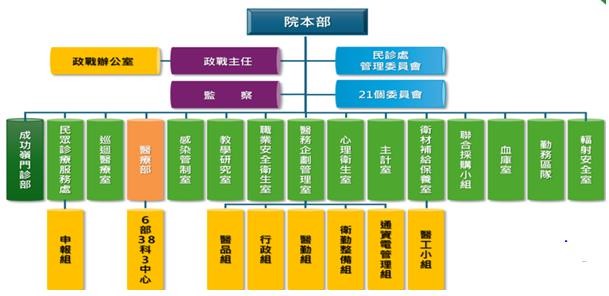
The hospital is led by the Director, who serves as the highest decision-making and supervisory authority. Through a hierarchical authorization system and a professional division of labor, the Director coordinates the advancement of medical care, teaching, research, and administrative management to ensure alignment between the organization’s strategic direction and operational goals. Each department carries out its duties according to its defined responsibilities and authorities, enhancing decision-making efficiency and execution effectiveness through regular meetings, performance monitoring, and cross-departmental coordination. These measures ensure the quality of medical services and maintain stable organizational operations.
Regarding governance systems, in addition to adhering to the existing management regulations of the national defense medical system, the hospital continuously strengthens internal controls and supervisory mechanisms by establishing institutionalized risk management and audit systems to enhance governance transparency and organizational resilience. To ensure compliance with laws, regulations, and management standards, the hospital has established an Inspection Office as an independent supervisory unit responsible for internal audits, regulatory compliance checks, integrity management, and risk monitoring. This office regularly reviews the effectiveness of operational processes and control measures, providing recommendations for improvement and follow-up mechanisms based on audit results.
Through a robust governance framework, internal control systems, and risk supervision mechanisms, the hospital consistently upholds principles of integrity management, regulatory compliance, and responsible governance. It enhances decision-making transparency and management effectiveness, with a focus on improving medical quality, protecting patient rights, and creating sustainable value. This approach gradually establishes a modern medical governance system characterized by professionalism, efficiency, and resilience.
Management Team Compensation and Performance
The hospital’s compensation system is based on the “Salary Payment Guidelines for Military Personnel and Employees” issued by higher authorities, ensuring fairness and consistency in the salary structure. The Director’s performance is evaluated by the competent authority of the Military Medical Bureau of the Ministry of National Defense. The Deputy Director undergoes an annual comprehensive performance evaluation in accordance with the “Performance Evaluation Regulations for Volunteer Officers, Non-Commissioned Officers, and Volunteer Soldiers of the Armed Forces,” as well as the “Performance Evaluation Regulations for Army, Navy, and Air Force Officers and Non-Commissioned Officers” and their enforcement rules. Evaluation criteria include ideology, morality, ability, knowledge, performance, and physical fitness, categorized into nine performance levels. Preliminary evaluations are completed by the end of each year and submitted for review, with final annual performance assessments finalized at the beginning of the following year. The evaluation results influence personnel promotion, selection, and training opportunities, ensuring transparency and fairness in personnel management.
Establishing Effective Communication Mechanisms
To enhance communication and build consensus on hospital operational strategies, Taichung Armed Forces General Hospital holds an annual “Management Strategy Consensus Camp” and participates in the Pan-Island Medical Strategy Alliance. Through exchanges and discussions with hospitals from different regions, new ideas are introduced to foster agreement and develop hospital management strategies that outline short-, medium-, and long-term goals. This process promotes unity and collaboration among all medical staff, benefiting both local military and civilian populations while improving the effectiveness of medical services. Additionally, the hospital conducts weekly meetings—including hospital affairs meetings, senior management meetings, medical department meetings, and operational management meetings—to plan and review major decisions and daily operations, ensuring continuous improvement in hospital management and medical quality.
Hospital Governance
The hospital has established a Sustainable Development Committee as the highest coordinating body for hospital-wide sustainability strategies and climate governance. The Director serves as Chairperson, responsible for approving overall strategic directions and reviewing major decisions. The Deputy Director and relevant senior executives comprise the core governance team, tasked with policy integration and cross-departmental coordination to ensure sustainability strategies are effectively embedded in all aspects of medical operations and administrative management. The committee includes functional executive structures made up of professional domain leaders who form task forces dedicated to environmental sustainability, social responsibility, and governance enhancement. Through regular reporting mechanisms, execution results are communicated back to the committee, creating a complete PDCA (Plan-Do-Check-Act) cycle of strategic planning, implementation, performance feedback, and continuous improvement for sustainable governance.
Regarding supply chain management and sustainable procurement, the hospital focuses on improving resource use efficiency while maintaining medical quality. It promotes a supply chain governance strategy of “cost-saving without quality reduction” and gradually introduces sustainable procurement and value-based purchasing concepts. By establishing an “integrated pricing and non-pricing medical materials negotiation and review mechanism,” the hospital integrates price review, demand assessment, and quality verification processes for medical materials procurement, transforming procurement decisions from a traditional cost-oriented approach to a management model that balances value and effectiveness.
In practical execution results for 2025, the hospital successfully saved over NT$3.15 million in medical materials procurement expenses through lean procurement and negotiation mechanisms. This achievement corresponds to an overall weighted negotiation price reduction of 4.14%, demonstrating that supply chain management optimization strategies have effectively improved resource utilization efficiency. Additionally, the proportion of non-pricing medical materials decreased to 25.88%, surpassing the annual target of 26.5%, further reflecting stable progress in procurement structure optimization and cost control measures.
Additionally, the hospital continues to strengthen its supplier management systems through annual revisions of procurement regulations, supplier evaluation mechanisms, and quality audit systems to ensure supply chain stability and consistent product quality. It also promotes professional capacity-building programs for procurement personnel, enhancing their understanding of regulatory compliance, ethical procurement, and sustainable supply chain management through on-the-job training. This ensures that procurement decisions adhere to principles of transparency, fairness, and professionalism. Since 2025, the hospital’s supplier evaluation system has gradually incorporated sustainable procurement indicators, requiring major suppliers to provide labor condition declarations and environmental compliance statements as basic criteria during procurement evaluations. The hospital will continue to improve its supply chain ESG (Environmental, Social, Governance) evaluation mechanism.
In its procurement strategy, the hospital actively employs a “most advantageous tender” selection mechanism, using quality, delivery reliability, long-term cost-effectiveness, and sustainability performance as comprehensive evaluation criteria rather than relying solely on price. This approach enhances the resilience and security of the medical supply chain and reduces operational risks associated with single-source suppliers.
The hospital’s organizational structure is depicted in the following diagram: