
1.11 Major Theme Identification Process
This sustainability report is prepared by Taichung Armed Forces General Hospital in accordance with the “GRI 3: Material Topics (2021)” standards issued by the Global Reporting Initiative (GRI). It integrates international sustainability disclosure trends with the characteristics of the healthcare industry, adopting a Double Materiality analysis approach to establish a systematic, data-driven, and stakeholder-engaged framework for identifying and managing material topics. The Double Materiality analysis evaluates each issue from two dimensions: first, the “outside-in” financial materiality, which assesses the impact of external environmental changes on the hospital’s operations; and second, the “inside-out” impact materiality, which assesses the extent to which the hospital’s operational activities affect the external environment and stakeholders. These two dimensions together form the dual-axis basis of the hospital’s materiality matrix. Through this framework, the hospital comprehensively inventories the actual and potential impacts of its operations on the economy, environment, and society, while simultaneously evaluating the level of concern from external stakeholders and the degree of internal operational impact. This ensures that sustainability disclosures both comply with international standards and accurately reflect the public value of the healthcare institution.
Regarding the overall material topic management mechanism
The hospital focuses on four major steps: “understanding the organizational context,” “identifying actual and potential impacts,” “assessing the significance of impacts,” and “confirming material topics and information disclosure.” It establishes an integrated top-down and bottom-up analytical process, transforming sustainability issues from initial collection, classification, and screening into core management topics with decision-making significance. These topics are further linked to operational strategy, risk management, and resource allocation, forming a continuously optimized sustainability governance system.
The hospital systematically promotes the identification of material topics through the following four core steps:
| Step | Phase | Main Work Content |
|---|---|---|
| Step 1 | Understand the organizational context | Referencing international frameworks such as GRI, SASB, TCFD, SDGs, and healthcare industry trends, initially compile 60 potential sustainability issues to ensure the issue pool is comprehensive and aligned with international standards. |
| Step 2 | Identify actual and potential impacts | Coordinated by the Sustainability Development Committee, conduct impact pathway analysis, classify and consolidate based on factors such as scope of impact, frequency of occurrence, reversibility, and time scale, select 27 highly relevant significant issues, and transform them into questionnaire items. |
| Step 3 | Assess Impact Significance | Collected 421 valid stakeholder questionnaires (covering six major groups) and 10 professional evaluation questionnaires from core executives. Both “impact degree” and “importance degree” were rated on two axes: importance was scored from 1 to 5, and impact degree was ranked from 1 to 27 in terms of importance. A dual-axis materiality matrix was established, with statistical weighting used to verify the grading. |
| Step 4 | Confirm Material Topics and Disclosure | After review by the Sustainability Development Committee, 12 highly material topics were finalized as the core disclosure content of this report. These were integrated into the OKR/OGSM management framework and PDCA tracking mechanism, transforming them into quantifiable performance indicators. |
Step-by-Step Execution Instructions
(1) Understanding the Organizational Context: Building an Issue Repository (60 Potential Issues)
Our hospital identified six major stakeholder groups through internal discussions, expert consultations, and analysis of sustainable practices from both domestic and international healthcare institutions. These groups include internal staff, patients and their families, regulatory and accreditation bodies, military units, community residents, and suppliers or contractors.
Based on the aforementioned international frameworks and healthcare industry trends, we developed an issue database encompassing five key dimensions: Performance Management, Social Participation, Excellence in Healthcare, Environmental Sustainability, and a Happy Workplace. Initially, 60 potential sustainability issues were identified to ensure that the sources of these issues are comprehensive and aligned with international standards.
(2) Identifying Actual and Potential Impacts: Narrowing the Focus to 27 Issues
The hospital’s Sustainability Development Committee coordinated the integration of issue content and conducted an impact pathway analysis. Each of the 60 potential issues was evaluated according to the following four criteria:
- Scope of Impact: The extent of the impact (within the hospital, regional, or national levels)
- Frequency: The likelihood and regularity of occurrence
- Reversibility: The extent to which the impact can be reversed and the difficulty of recovery.
- Time Scale: The short-, medium-, or long-term duration of the impact.
After classification and refinement, 27 major issues highly relevant to hospital operations were identified. These issues fall under five key dimensions and were transformed into specific questionnaire items to facilitate subsequent quantitative evaluation by stakeholders.
(3) Assessing Impact Significance: A Dual-Axis Quantitative Questionnaire Evaluation
The hospital distributed questionnaires to six major stakeholder groups, collecting a total of 421 valid responses, along with 10 professional evaluation questionnaires completed by core management personnel. The sample composition is as follows:
| Number | Stakeholder Group | Valid Questionnaires | Proportion |
|---|---|---|---|
| 1 | Internal staff | 142 copies | 33.73% |
| 2 | Patients and family members | 52 copies | 12.35% |
| 3 | Supervisory Authorities and Certification Bodies | 25 copies | 5.94% |
| 4 | Military Units | 36 copies | 8.55% |
| 5 | Community Residents | 14 copies | 3.33% |
| 6 | Suppliers/Contractors | 152 copies | 36.10% |
| Total | Six major groups | 421 copies | 100% |
| Additionally | Core cadre professional evaluation questionnaires | 10copies | weighted separately |
※ Explanation of the Scoring Scale: Importance is rated on a scale from 1 to 5 points, where 1 = Not important at all, 2 = Slightly important, 3 = Neutral, 4 = Important, and 5 = Very important. Impact is ranked from 1 to 27 based on importance. Impact is presented as the average ranking score of 10 core executives (calculated as 28 minus the ranking). Importance is shown as the total score from questionnaires completed by six major stakeholder groups. The overall ranking is determined by combining the two-axis ranking values to establish the final priority order.
Our institution’s questionnaire employs a 1-to-5 Likert scale to evaluate 27 issues individually, assessing both their “impact ranking” (X-axis) and “importance rating” (Y-axis).
- Impact (X-axis): Measures the actual effect each issue has on the institution’s operations, ranked from 1 to 27 by importance. Issues with a higher impact are ranked 1, while those with a lower impact are ranked 27. The higher the rank, the more significant the impact on the institution, positioning the issue further to the right on the matrix.
- Importance (Y-axis): Measures stakeholders’ attention to and concern for each issue, rated on a scale from 1 to 5. Higher scores indicate greater overall stakeholder importance, positioning the issue higher on the matrix.
After statistical weighting and validation, the two-axis values are assigned as coordinates on the materiality matrix, positioning each issue accordingly. The composite score is calculated by summing the impact ranking and importance ranking, serving as the final basis for materiality classification.
(4) Confirmation of Material Topics and Disclosure of Information
After review by the Sustainable Development Committee and based on the dual-axis matrix classification results, 12 highly material topics were finalized as the core disclosure content of this report, corresponding to management policies and performance indicators in each chapter. Additionally, the institution has integrated the material topic management mechanism into the OKR and OGSM management frameworks, transforming them into quantifiable performance indicators and annual action plans. Through internal audits and performance tracking mechanisms, a PDCA management cycle is established to ensure continuous improvement in sustainable governance.
Overall, by adhering to the GRI 3 guidelines to develop the double materiality analysis process, the identification of material topics becomes both systematic and traceable. This approach not only improves the quality of sustainability information disclosure but also enhances resource allocation efficiency and strategic decision-making capabilities. Through this analytical framework, the institution can more accurately identify key risks and development opportunities, thereby continuously strengthening the sustainability resilience and long-term competitiveness of the healthcare system.
Materiality Analysis Matrix
The materiality analysis matrix, confirmed by our institute, presents the results of an analysis of 27 sustainability issues. The table below displays the dual-axis scores, rankings, and materiality classifications of these issues, arranged in descending order according to their comprehensive ranking.
| Item No. | Code | Issue Name | Impact Level (Points) | Impact Ranking | Importance Level (Points) | Importance Ranking | Overall Score | Overall Ranking | Significance Classification |
|---|---|---|---|---|---|---|---|---|---|
| 1 | E6 | Talent Training and Development | 21.9 | 25 | 338.7 | 27 | 52 | 27 | Highly Significant |
| 2 | C3 | Medical Quality and Patient Safety | 22.1 | 27 | 338.3 | 24 | 51 | 26 | Highly Significant |
| 3 | D1 | Energy Management | 21.2 | 23 | 325 | 26 | 49 | 25 | Highly Significant |
| 4 | D5 | Low-Carbon Hospital | 19.6 | 20 | 315.2 | 25 | 45 | 24 | Highly Significant |
| 5 | A3 | Hospital Governance and Sustainable Operation | 22.1 | 27 | 332.1 | 17 | 44 | 23 | Highly Significant |
| 6 | A5 | Risk Management and Emergency Response | 20.5 | 22 | 334.3 | 19 | 41 | 22 | Highly Significant |
| 7 | A4 | Operational Performance and Financial Status | 21.9 | 25 | 329.9 | 14 | 39 | 21 | Highly Significant |
| 8 | C1 | Doctor-Patient Relationship | 16.8 | 18 | 333.8 | 20 | 38 | 20 | Highly Significant |
| 9 | A2 | Regulatory Compliance | 16.3 | 17 | 332.3 | 21 | 38 | 20 | Highly Significant |
| 10 | C5 | Smart Healthcare | 14.7 | 15 | 329.2 | 23 | 38 | 20 | Highly Significant |
| 11 | A1 | Sustainable Management of Medical Environment | 19.7 | 21 | 329.2 | 12 | 33 | 15 | Highly Significant |
| 12 | B1 | Community Health Promotion and Disease Prevention | 13.6 | 13 | 328.6 | 22 | 35 | 16 | Highly Significant |
| 13 | D2 | Water Resource Management | 17.9 | 19 | 321.3 | 18 | 37 | 17 | Moderately Significant |
| 14 | B3 | Local Community Cooperation and Health Network Establishment | 11.3 | 10 | 331.1 | 15 | 25 | 14 | Moderately Significant |
| 15 | D3 | Resource Recycling and Regeneration | 14.4 | 14 | 321.4 | 11 | 25 | 14 | Moderately Significant |
| 16 | D4 | Sustainable Supply Chain | 13.3 | 12 | 323.6 | 13 | 25 | 14 | Moderately Significant |
| 17 | B4 | Chronic Diseases and Long-term Care Support | 8.6 | 6 | 331.5 | 16 | 22 | 11 | Low Significance |
| 18 | C6 | Specialized Medical Care | 11.7 | 11 | 323.6 | 9 | 20 | 10 | Low Significance |
| 19 | C4 | Patient Satisfaction | 15.5 | 16 | 321.2 | 3 | 19 | 9 | Low Significance |
| 20 | E1 | Safe and Healthy Work Environment | 9.5 | 7 | 339.2 | 10 | 17 | 8 | Low Significance |
| 21 | C2 | Military Field Medicine | 11.3 | 10 | 322 | 6 | 16 | 7 | Low Significance |
| 22 | E4 | Good Communication and Sense of Participation | 9.6 | 8 | 338 | 8 | 16 | 7 | Low Significance |
| 23 | E3 | Respectful and Friendly Workplace Culture | 6.2 | 5 | 337.9 | 5 | 10 | 5 | Low Significance |
| 24 | E2 | Reasonable Salary and Benefits System | 5.5 | 4 | 339.1 | 4 | 8 | 4 | Low Significance |
| 25 | B2 | Medical Care for Disadvantaged Groups | 3.6 | 1 | 323 | 7 | 8 | 4 | Low Significance |
| 26 | B5 | Volunteer Services and Hospital Social Responsibility | 4.6 | 3 | 320.9 | 2 | 5 | 2 | Low Significance |
| 27 | E5 | Employee Care Measures | 4.6 | 3 | 338.3 | 1 | 4 | 1 | Low Significance |
The matrix diagram of major issues of this institute is shown in the figure below:
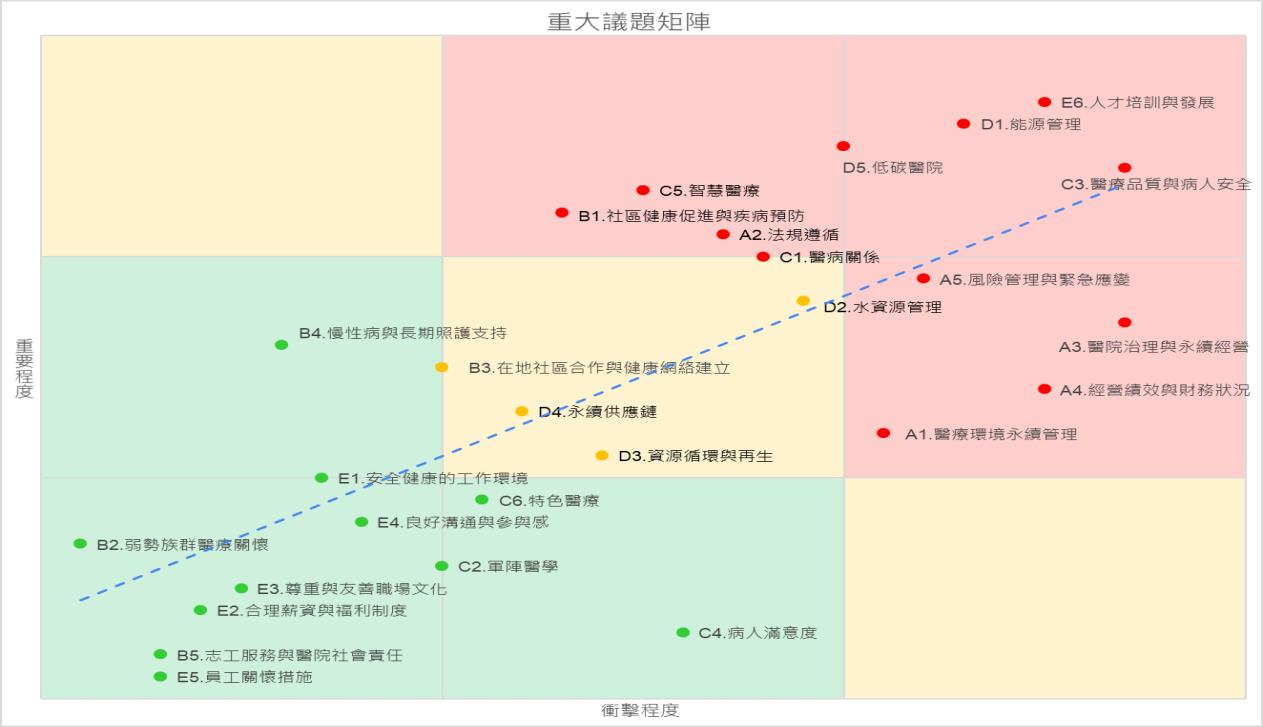
Based on the dual-axis scoring results, this institute jointly determined the impact level and importance level, categorizing 27 issues into three levels of significance:
| Matrix Position | Significance Ranking | Quantity | Covered Topics (Ranked from High to Low Based on Comprehensive Sorting) |
| Top right pink | Highly significant issues |
12 items |
E6 Talent Training and Development, C3 Medical Quality and Patient Safety, D1 Energy Management, D5 Low-Carbon Hospital, A3 Hospital Governance and Sustainable Operation, A5 Risk Management and Emergency Response, A4 Operational Performance and Financial Status, C1 Doctor-Patient Relationship, A2 Regulatory Compliance, C5 Smart Healthcare, A1 Sustainable Management of Medical Environment, B1 Community Health Promotion and Disease Prevention |
| Middle Yellow | Moderate Major Issue | 4 items | B3 Local Community Collaboration and Health Network Establishment, D2 Water Resource Management, D3 Resource Recycling and Regeneration, D4 Sustainable Supply Chain |
| Bottom left green | Low-level major issue | 11 items | B2 Medical care and support for disadvantaged groups , B4 Chronic disease and long-term care support, B5 Volunteer services and hospital social responsibility , C2 Military medicine, C4 Patient satisfaction, C6 Specialized medical services , E1 Safe and healthy working environment, E2 Fair salary and benefits system , E3 Respectful and friendly workplace culture, E4 Good communication and sense of participation, E5 Employee care measures |
The 12 highly significant issues located in the upper-right area of the matrix, which exhibit both high stakeholder concern and high operational impact, are prioritized sustainability management matters for our institution. This report fully discloses and explains the management performance related to these issues. The 4 moderately significant issues in the central area are continuously monitored and improved through routine management measures. The 11 low-significance issues in the lower-left area are incorporated into daily management processes, with ongoing attention to their development trends and potential impacts.
Our institution will allocate appropriate management resources according to the significance of each issue, develop management policies, performance indicators, and action plans, and address stakeholder expectations through regular reviews and continuous improvement mechanisms to achieve sustainable governance objectives.
List of Major Themes and Corresponding Chapters of Our Institution
| Priority Level | Issue Number | Major Topic | Corresponding Chapter |
|
Highly Significant |
A1 | Medical Environment Sustainable Management | 2.5 |
| A2 | Regulatory Compliance | 2.3 | |
| A3 | Hospital Governance and Sustainable Operation | 2.1 | |
| A4 | Operational Performance and Financial Status | 2.2 | |
| A5 | Risk Management and Emergency Response | 2.4 | |
| B1 | Community Health Promotion and Disease Prevention | 3.1 | |
| C1 | Doctor-Patient Relationship | 4.2 | |
| C3 | Medical Quality and Patient Safety | 4.1 | |
| C5 | Smart Healthcare | 4.3 | |
| D1 | Energy Management | 5.1 | |
| D5 | Low-Carbon Hospital | 5.1 | |
| E6 | Talent Training and Development | 6.1 | |
| Moderate Major | B3 | Local Community Collaboration and Health Network Establishment | 3.2 |
| D4 | Sustainable Supply Chain | 2.1 | |
| D2 | Water Resource Management | 5.2 | |
| D3 | Resource Circulation and Regeneration | 5.3 | |
| Low to Moderate Importance | B4 | Chronic Disease and Long-term Care Support | 3.3 |
| B2 | Medical Care for Vulnerable Groups | 3. 4 | |
| B5 | Volunteer Services and Hospital Social Responsibility | 3.2 | |
| C2 | Military Medicine | 4.5 | |
| C4 | Patient Satisfaction | 4.2 | |
| C6 | Specialized Medical Services | 4.5 | |
| E1 | Safe and Healthy Work Environment | 6.2 | |
| E2 | Reasonable Salary and Benefits System | 6.3 | |
| E3 | Respectful and Friendly Workplace Culture | 6.4 | |
| E4 | Good Communication and Sense of Participation | 6.4 | |
| E5 | Employee Care Measures | 6.4 |
Our hospital follows a materiality analysis procedure that comprehensively considers stakeholder concerns, operational impact, and sustainability development trends to complete the materiality grading of various issues. For highly material issues, this report provides full disclosure and detailed explanations of management performance. Moderately material issues are integrated into daily management and continuous monitoring mechanisms, with management intensity and disclosure depth adjusted promptly in response to operational changes and risk scenarios. For the 11 low-materiality issues, our hospital continues to manage them in accordance with legal regulations and internal management systems. This includes occupational safety and health, managed according to the Occupational
Safety and Health Act (detailed in Chapter 6.2), and the salary system, handled according to Ministry of National Defense regulations (detailed in Chapter 6.3), among others, all maintaining basic management operations. Our hospital will reassess the importance of these issues annually, and if there is a significant increase in external environmental factors or stakeholder concern, the materiality grading and disclosure depth will be adjusted accordingly.
Overall, Taichung Armed Forces General Hospital has established a systematic, transparent, and strategy-oriented sustainability issue management mechanism by adopting international sustainability standards and a double materiality analysis approach. This mechanism effectively integrates stakeholder perspectives with internal governance requirements, enhancing the quality of sustainability report information and alignment with international standards. Additionally, it strengthens cross-departmental collaboration, extending sustainability governance from information disclosure to strategic decision-making and operational management.
In the future, our hospital will continue to optimize material topic analysis methods, strengthen ESG data governance and information system integration capabilities, and gradually introduce digital stakeholder feedback mechanisms and real-time monitoring tools to enhance the timeliness and accuracy of issue identification. These efforts will ensure that our sustainability strategies effectively respond to changes in the external environment and trends within the healthcare industry, continuously advancing the medical system toward the sustainable development goals of high resilience, quality, and efficiency.