
5.1 Energy Management and Low-Carbon Hospitals
- Deepening Energy Management Practices
- In terms of energy management implementation
- In terms of building and facility management
- In terms of energy performance
- Third-Party Certification
- Demonstrating a Net-Zero Future to the Outside World: Achievements and the Long-Term Transformation Path
- Regarding Energy Management Performance
- Looking Ahead
Deepening Energy Management Practices
Facing challenges such as global climate change, energy price fluctuations, and the growing demand for medical services, our hospital has adopted “low-carbon healthcare and sustainable operations” as its core development strategy. We have integrated energy management, greenhouse gas reduction, and intelligent operations into our overall governance framework, striving to build a sustainable healthcare system that balances environmental responsibility, medical quality, and operational resilience. Our hospital firmly believes that low-carbon transformation is not only an expression of environmental responsibility but also a critical strategy to enhance organizational resilience and sustainable competitiveness. Therefore, through institutionalized management, data-driven decision-making, and cross-departmental collaboration, we continuously promote improvements in energy efficiency and carbon emission management.
Our hospital has established a long-term goal to reduce overall energy consumption by 1% annually compared to the previous year. By implementing energy management systems, equipment replacement plans, and energy-saving improvement measures, we continuously enhance energy efficiency and carbon reduction management capabilities, steadily progressing toward the vision of low-carbon transformation and net-zero emissions.
Since 2016, our hospital has implemented the ISO 50001 Energy Management System and obtained certification for the first time on December 1, 2017. We subsequently completed recertification on December 1, 2020, and were honored with a certificate of successful energy management system recertification issued by the Energy Bureau of the Ministry of Economic Affairs. On April 22, 2024, we completed recertification again and have continuously passed annual surveillance audits, maintaining the certification’s validity to date. Through the implementation of the ISO 50001 Energy Management System, our hospital has gradually established a comprehensive energy audit system, energy performance indicators, and regular review and improvement mechanisms, forming a PDCA (Plan-Do-Check-Act) management cycle.
In terms of energy management implementation
Our hospital uses Microsoft Excel to develop an energy management platform that integrates data on electricity, fuel, water resources, and major equipment operations. Through real-time monitoring, trend analysis, and anomaly detection mechanisms, we continuously track energy usage, providing a critical foundation for energy-saving improvements and investment decisions. Energy governance is coordinated and implemented by the energy management task force, with active participation from various administrative units and clinical representatives. Through cross-departmental collaboration, energy-saving measures are promoted, elevating energy management from basic equipment oversight to comprehensive hospital-wide governance.
In recent years, our hospital has consistently promoted the replacement of high-energy-consuming equipment and implemented energy-saving improvement measures. These initiatives include enhancing the efficiency of chiller units, applying zoned load control for air conditioning systems, gradually upgrading lighting equipment, establishing smart power monitoring systems, and managing peak loads. By improving equipment performance and optimizing system management, we have continuously reduced energy consumption and operating costs.
The primary energy-saving equipment replacement achievements of our hospital from 2021 to 2025 are as follows:
| Item Number | Name of Equipment to be Replaced | Year of Replacement | Replacement Cost (NT$) | Amount Saved (kWh/year) |
|---|---|---|---|---|
| 1 | Medical Building Chilled Water Main Unit 450RT | 2021 | 8,360,000 | 410,573 |
| 2 | Medical Building Chilled Water Main Unit 300RT | 2023 | 5,569,900 | 274,752 |
| 3 | Transformer Replacement (6 units) | 2023 | 5,480,000 | 92,389 |
| 4 | Medical Building Air Compressor and Box-type Air Conditioner Replacement | 2024 | 736,005 | 11,872 |
| 5 | Comprehensive Building South Machine Room Chilled Water Main Unit | 2025 | 6,520,000 | 241,824 |
In terms of building and facility management
The hospital’s emergency and critical care medical building received Gold-level Green Building candidate certification and Silver-level Smart Building candidate certification during the planning and design phase. Utilizing a central monitoring system that integrates air conditioning, lighting, and environmental data, the building achieves transparent and intelligent energy management. Simultaneously, ongoing efforts to upgrade water-saving equipment and analyze water flow have established a dual-track, low-carbon foundation for both energy and water resource management, progressively creating a sustainable infrastructure to support the hospital’s net-zero transformation.
In terms of energy performance
The hospital has consistently implemented energy-saving measures over the past three years, resulting in the following energy report outcomes:
| Year | Electricity Saved (kWh) | Electricity Saving Rate |
|---|---|---|
| 2023 | 192,363 | 2.10% |
| 2024 | 275,354 | 2.28% |
| 2025 | 84,443 | 1.24% |
The energy consumption of this institute from 2023 to 2025 is as follows:
| Quantitative Indicators | Unit | Year 2023 | Year 2024 | Year 2025 |
|---|---|---|---|---|
| Electricity | kWh/year | 6,250,430 | 6,461,451 | 6,285,415 |
| Electricity | GJ | 22,502 | 23,261 | 22,627 |
| Gasoline | L/年 | 6,443 | 6,473 | 5,734 |
| Gasoline | GJ | 2,075 | 2,084 | 1,846 |
| Diesel | L/年 | 4,965 | 7,245 | 8,401 |
| Diesel | GJ | 185 | 270 | 313 |
| Total Energy | GJ | 24,761 | 25,615 | 24,786 |
| Floor Area | m² | 55,485 | 55,485 | 55,485 |
| Energy Density | GJ/m² | 0.446 | 0.462 | 0.447 |
Our hospital actively promotes greenhouse gas inventory and carbon management as essential foundations for advancing net-zero transformation and developing low-carbon healthcare. To assess the impact of our operational activities on climate change, we completed the 2024 greenhouse gas inventory in accordance with the ISO 14064-1 international standard. Additionally, we commissioned DNV GL (DNV Lienwei International Verification Co., Ltd.) to conduct third-party verification, ensuring the reasonableness, consistency, and credibility of the inventory boundary setting, emission factor selection, and calculation methods.
In 2025, our hospital participated in a project led by the Ministry of Health and Welfare to develop a hospital-wide organizational greenhouse gas inventory system for the year 2023. We established a comprehensive management framework for Scope 1 and Scope 2 emissions, encompassing major emission sources such as generator fuel oil, official vehicle fuel, refrigerant leaks (R32, R410A), and anesthetic gases (sevoflurane). Standardized inventory procedures and data management systems were implemented to enhance the accuracy, completeness, and traceability of emission data.
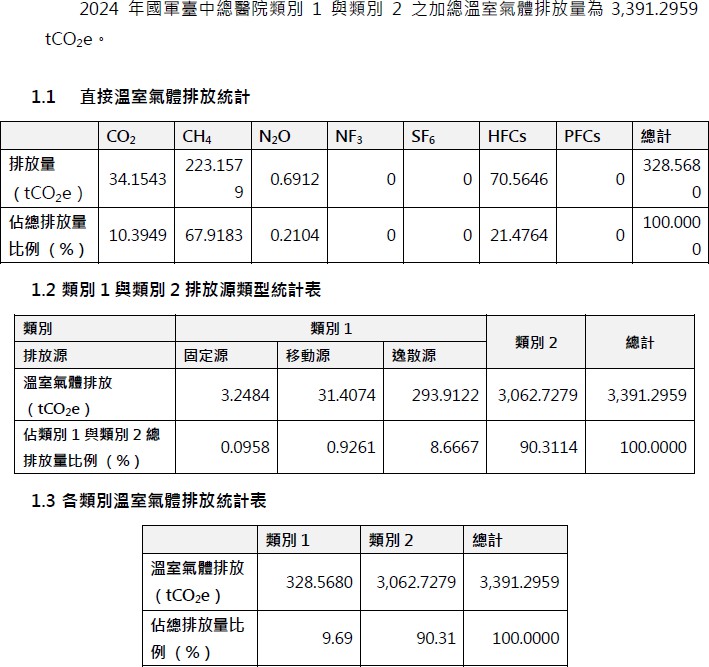
The 2024 inventory results indicate that Category 1 (Scope 1) greenhouse gas emissions totaled 328.5680 tCO₂e, primarily from stationary combustion sources and medical equipment use. Category 2 (Scope 2) emissions amounted to 3,062.7279 tCO₂e, demonstrating that purchased electricity remains the hospital’s main source of emissions. The energy consumption structure significantly influences overall carbon emissions. The total greenhouse gas emissions for 2024 were 3,391.2959 tCO₂e, establishing the baseline year for the hospital’s future greenhouse gas reduction initiatives and performance monitoring.
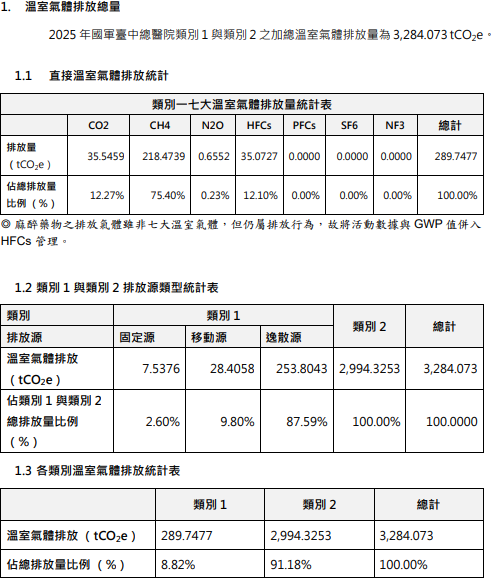
In 2025, the hospital continued to conduct greenhouse gas inventories using the same boundaries and methods. The results showed that Category 1 (Scope 1) emissions were 289.75 tCO₂e, a decrease of 38.82 tCO₂e compared to 2024; Category 2 (Scope 2) emissions were 2,994.33 tCO₂e, a decrease of 68.40 tCO₂e compared to 2024. Total emissions for 2025 were 3,284.07 tCO₂e, a reduction of 107.22 tCO₂e, or 3.16%, compared to the 2024 baseline year, demonstrating that the hospital’s energy management and carbon reduction measures have gradually become effective.
According to ISO 14064-1 standards, our hospital has established a materiality threshold of less than 5% of total greenhouse gas emissions. After evaluation, no significant changes were identified in the organizational boundary, emission sources, or inventory methods in 2025. Additionally, the differences in inventory results did not exceed the threshold for resetting the baseline year. Therefore, 2024 will continue to serve as the baseline year for greenhouse gas reduction management, forming the basis for subsequent carbon reduction performance tracking, target setting, and evaluation of management measure effectiveness.
The 2024 greenhouse gas inventory results for our hospital are as follows:
The results of this institute’s 2025 greenhouse gas inventory are as follows:
The greenhouse gas emission performance of this institute from 2023 to 2025 is as follows:
| Quantitative Indicators | Unit | Year 2023 | Year 2024 | Year 2025 |
|---|---|---|---|---|
| Category 1 (Scope 1) | tCO2e | 288 | 328.5680 | 289.7477 |
| Category 2 (Scope 2) | tCO2e | 3087.7124 | 3062.7279 | 2994.3253 |
| Category 1 + Category 2 (Scope 1, Scope 2) | tCO2e | 3,376 | 3391.2959 | 3284.073 |
| Total | tCO2e | 3,376 | 3391.2959 | 3284.073 |
| Inpatient Days | Inpatient Days | 97,873 | 100,727 | 98,975 |
| Emission Intensity | tCO₂e/person-day | 0.03449 | 0.03367 | 0.03318 |
Note: Emission intensity is calculated as total emissions divided by inpatient days, rounded to five decimal places.
Third-Party Certification
| Third-Party Certification Items | Year 2023 | Year 2024 | Year 2025 |
|---|---|---|---|
| Certification Authority | None | DNV Business Assurance Co., Ltd. | DNV Business Assurance Co., Ltd. |
| Certificate Issuance Date | None | 2025/7/24 | 2026/3/26 |
Based on the analysis of the 2025 inventory results, approximately 98% of this hospital’s greenhouse gas emissions originate from purchased electricity, indicating that electricity consumption remains the primary source of carbon emissions. Therefore, the hospital plans to install a solar photovoltaic system in 2026 to gradually increase the share of self-generated renewable energy, reduce reliance on purchased electricity, and serve as a key strategy for achieving net-zero emissions and facilitating the energy transition.
The organizational greenhouse gas inventories for 2024 and 2025 have both undergone third-party verification, demonstrating that the hospital’s carbon management system has progressively established a robust management foundation. Scope 1 emissions in 2025 decreased from 328.5680 tons in 2024 to 289.7477 tons, primarily due to a reduction in the number of visitors to the hospital, which led to lower emissions associated with septic tanks. Scope 2 emissions declined from 3,062.7279 tons to 2,994.3253 tons, mainly as a result of an overall reduction in electricity consumption and the continued effectiveness of energy-saving measures. However, with the new acute and critical care medical building scheduled for completion and operation in 2026, the hospital anticipates challenges related to increased overall energy consumption and carbon emissions and has proactively planned corresponding energy-saving strategies.
In addition to energy management, the hospital is actively promoting the low-carbon transformation of clinical processes by integrating sustainability concepts into core medical workflows. The management strategy of “saving resources without compromising quality” is implemented to enhance resource use efficiency through process optimization, source reduction, and digital transformation, all while maintaining medical quality and patient safety.
The hospital continues to advance electronic medical records and paperless ward operations. By integrating digital information systems and electronic document management, it reduces paper usage and the need for physical storage space, lowers energy consumption for lighting and air conditioning, and simultaneously enhances data retrieval efficiency and administrative operational effectiveness.
The Department of Emergency Medicine has optimized physician order processes and reduced duplicate errors by integrating order sets and establishing an ICD-10 mapping system. Additionally, it has fully implemented an electronic consent form system with a 100% digital usage rate, significantly reducing paper and printing material consumption and demonstrating tangible results in digital carbon reduction.
The Hemodialysis Center has implemented source reduction improvements by introducing powdered dialysis solution. Prior to this change, approximately 2,800 barrels of liquid dialysis B solution were used monthly, requiring the daily handling of 120 barrels weighing a total of 456 kilograms. Preparation time was 85 minutes, and about 4,200 empty plastic barrels were generated each month, costing approximately NT$262,500 monthly. After the improvement, preparation time was reduced to 30 minutes—a 65% decrease. Daily handling weight dropped to 36 kilograms, a 92% reduction. Storage space requirements decreased by 75%, to 2.7 square meters. The number of empty plastic barrels was reduced by 67%, saving about 2,800 barrels per month. Monthly cost savings reached approximately NT$91,500, with annual savings exceeding NT$1.1 million. These results clearly demonstrate the benefits of a circular economy and source reduction.
The Hemodialysis Center’s implementation of powdered dialysis solution for source reduction has yielded the following results:
| Item | Before Improvement | After Improvement | Improvement Effectiveness |
|---|---|---|---|
| Monthly Dialysate B Solution Cost | 262,500 yuan | 172,500 yuan | 0.343 |
| Dialysate Storage Space | 10.5 square meters | 2.7 square meters | 0.743 |
| Plastic waste | 4,200 pieces/month | 1,400 pieces/month | 0.67 |
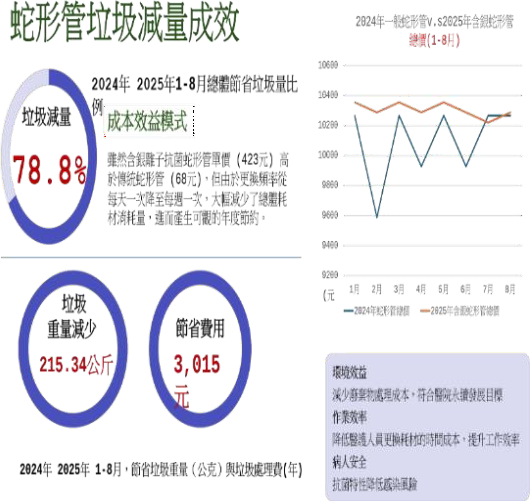 The Anesthesia Department has addressed this issue from the perspectives of supply chain management and consumable reduction. After introducing silver ion serpentine tubes, the replacement frequency was extended from once daily to once every seven days. From January to August 2025, the usage of serpentine tubes decreased by 78.8% compared to the same period the previous year. Simultaneously, through a local procurement strategy, product transportation distances were shortened, reducing indirect carbon emissions associated with the supply chain and gradually strengthening the foundation for managing Scope 3 emissions. Since the initial inventory capability is still under development, complete Scope 3 quantification data for 2025 are not yet available. The hospital plans to complete trial calculations and disclosures for major categories in 2026.
Looking ahead, the hospital will continue to enhance its ISO 50001 energy management system, promote the adoption of renewable energy, strengthen greenhouse gas inventory management mechanisms, and advance low-carbon medical service models. By integrating smart healthcare, digital transformation, and circular economy principles, it will continuously improve energy efficiency and carbon management performance, progressively moving toward the goals of becoming a low-carbon, smart, and net-zero hospital. This approach will realize a long-term vision of environmental sustainability, social responsibility, and collaborative creation of medical value.
Demonstrating a Net-Zero Future to the Outside World: Achievements and the Long-Term Transformation Path
Medical institutions play a crucial role in the global transition to net-zero emissions. They are not only responsible for safeguarding public health but also committed to reducing environmental impact and promoting sustainable development. Taichung Armed Forces General Hospital continuously integrates sustainable development principles into its medical services and operational management. By enhancing institutional governance, expanding clinical carbon reduction initiatives, and strengthening sustainable supply chain management, the hospital is progressively building a sustainable healthcare system characterized by low carbon emissions, advanced technology, and resilience to address the challenges and responsibilities posed by climate change.
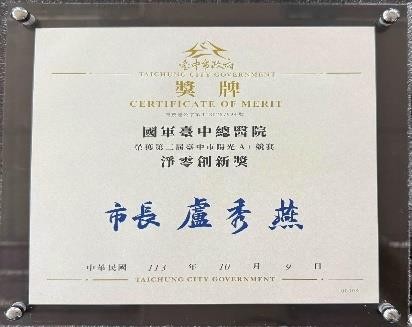
In advancing its net-zero transformation, the hospital has continuously strengthened its energy management systems and environmental sustainability governance. These efforts have garnered external recognition. In 2022, the hospital received the Ministry of Economic Affairs Energy Bureau’s Energy Saving Benchmark Award, and in 2024, it was honored with the Taichung City Government Net-Zero Innovation Award. These accolades demonstrate the hospital’s tangible achievements and innovative results in energy management, energy conservation, carbon reduction, and the promotion of sustainable development.
To enhance the impact of sustainable healthcare and promote social engagement, the hospital’s theme for the 2025 Medical Technology Exhibition is “Armed Forces Hospital Net-Zero Transformation—Building Sustainable Healthcare to Protect Military Personnel and Civilians.” The exhibition highlights the hospital’s accomplishments in institutionalizing energy management systems and the tangible outcomes of low-carbon medical practices. Through this open exchange platform, the hospital shares its expertise in energy-saving management, smart healthcare applications, and sustainable governance, demonstrating the Armed Forces medical system’s commitment and proactive efforts toward net-zero transformation.
Regarding Energy Management Performance
The hospital continues to advance energy-saving initiatives and enhance equipment efficiency. At the 2025 Medical Technology Exhibition, themed “Armed Forces Hospital Net-Zero Transformation—Building Sustainable Healthcare to Protect Military and Civilians,” it showcased its institutionalized energy management achievements and low-carbon medical practices. The 2025 energy declaration reported an electricity savings rate of 1.24% (compared to 2.21% in 2023 and 2.28% in 2024), demonstrating the hospital’s ongoing commitment to improving energy efficiency through structured energy management and equipment optimization. These efforts not only reduce energy consumption and greenhouse gas emissions but also enhance operational efficiency and resource utilization, exemplifying the simultaneous advancement of environmental sustainability and operational performance.
The hospital’s electricity savings rates for energy declarations from 2023 to 2025:
| Item | Year 2023 | Year 2024 | Year 2025 |
|---|---|---|---|
| Energy Saving Rate (%) | 2.21 | 2.28 | 1.24 |
Our institute was selected for the Energy Conservation Benchmark Award by the Energy Bureau of the Ministry of Economic Affairs in 2022.

2024 Taichung City Government Net Zero Innovation Award
Looking Ahead
Our hospital will continue to align with the national 2050 net-zero emissions policy, intensifying efforts to reduce medical carbon emissions and enhance climate governance mechanisms. We will integrate the concept of net-zero transformation into hospital governance, medical services, facility management, and supply chain operations across all aspects of our work. By continuously improving energy management systems, expanding low-carbon medical initiatives, promoting green procurement, and strengthening climate risk management capabilities, we aim to gradually develop a healthcare system that is environmentally resilient and sustainably competitive.
In the future, our hospital will continue to pursue the vision of a “Net-Zero Transformation of the Military Hospital—Building a Sustainable Medical Guard for Military Personnel and Civilians.” By integrating medical expertise with sustainable governance, we will balance patient health, environmental protection, and social responsibility. We will steadily progress toward becoming a low-carbon, smart, and resilient sustainable hospital, creating long-term value for the health of both military personnel and civilians, as well as for environmental sustainability.