
6.2 A safe and healthy working environment
Our hospital considers employees’ occupational safety, as well as their physical and mental health, to be fundamental elements for the sustainable operation of medical services. Adhering to the core principles of “prevention first, risk management, and continuous improvement,” we have established a comprehensive occupational safety and health management system dedicated to creating a safe, healthy, and resilient working environment.
Our hospital has legally established an Occupational Safety and Health Office as the primary management unit responsible for coordinating and planning occupational safety and health policies, conducting risk assessments, providing education and training, reporting accidents, and implementing follow-up improvements throughout the hospital. Additionally, an interdepartmental Occupational Safety and Health Committee has been formed, comprising senior hospital executives and representatives from relevant units. The committee holds regular quarterly meetings to review and monitor the effectiveness of occupational safety policies, address risk issues, and evaluate improvement measures, ensuring the effective operation and continuous enhancement of the occupational safety management system.
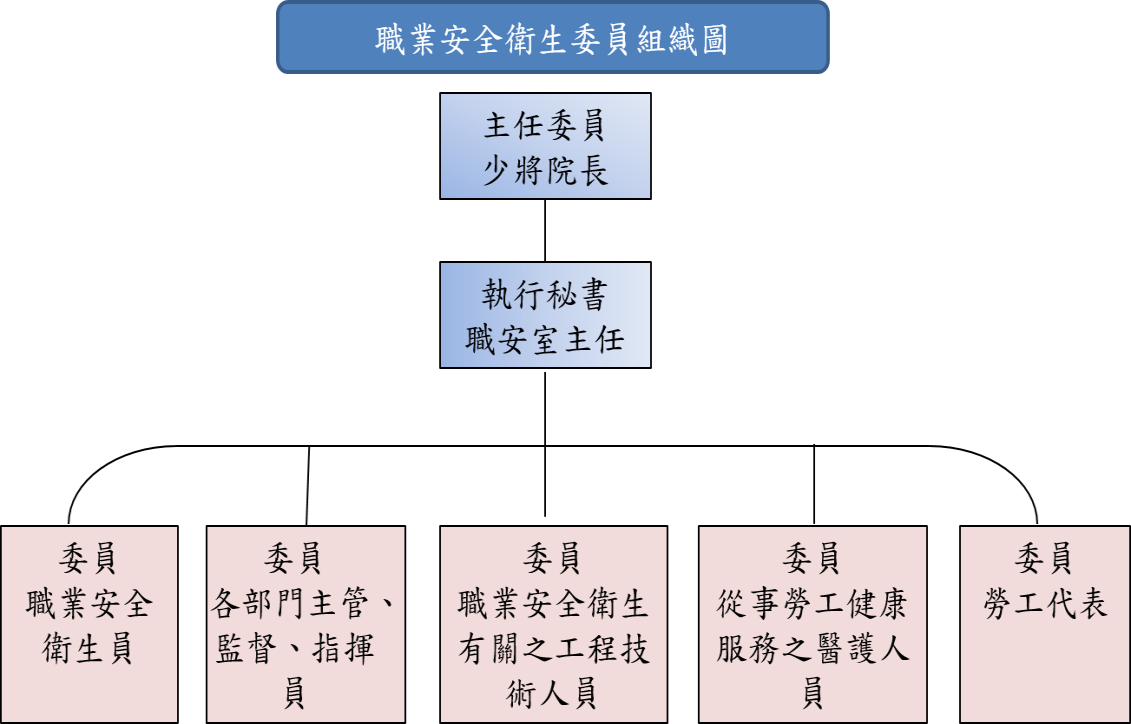
Occupational Safety and Health Committee
The organizational chart of our hospital’s Occupational Safety and Health Committee is as follows:
In terms of education, training, and enhancing risk awareness
Our hospital conducts annual occupational safety and health education and training courses for all employees. The curriculum covers a wide range of topics, including general safety and health knowledge, clinical operation risk identification, infection control, emergency response procedures, and chemical safety management. We also maintain a 100% completion rate for these training sessions. Additionally, personnel involved in specific hazardous operations and related duties, as mandated by law, are required to complete statutory professional training and certification. This ensures they possess the necessary professional knowledge and operational skills, thereby minimizing potential workplace risks.
Statistics on Occupational Safety Personnel Certification Conducted by Our Hospital in 2025
| Item Number | Occupational Safety Certificate Name | Number of People |
|---|---|---|
| 1 | Class A Occupational Safety and Health Business Supervisor | 3 |
| 2 | Occupational Health Management | 1 |
| 3 | Occupational Safety and Health Administrator | 1 |
| 4 | Labor Health Service Nurse | 1 |
| 5 | Construction Industry Class A Occupational Safety and Health Business Supervisor | 1 |
| 6 | Type 1 Pressure Vessel Operator | 17 |
| 7 | High-Pressure Gas Specific Equipment Operator | 5 |
| 8 | Organic Solvent Work Supervisor | 5 |
| 9 | Specific Chemical Substance Work Supervisor | 14 |
| 10 | Oxygen-Deficient Work Supervisor | 1 |
Our hospital’s Employee Occupational Safety Education and Training Courses for 2023-2025:
| Year | Course Topic | Number of Trainees (person-times) | Training Hours (hours) |
|---|---|---|---|
| Year 2023 | Analysis of Common Occupational Safety, Health, and Hygiene Hazards in Hospitals | 787 | 1 |
| Year 2023 | Common Occupational Safety, Health, and Hygiene Management Measures in Hospitals | 787 | 1 |
| Year 2024 | Common Hazards for Medical Institution Employees | 794 | 1 |
| Year 2024 | Medical Institutions Corresponding to GRI 403 Occupational Safety and Health Ten Indicators | 794 | 1 |
| Year 2025 | Analysis of Partial Amendments to the Occupational Safety and Health Act | 769 | 1 |
| Year 2025 | Introduction to Workplace Illegal Infringements | 769 | 1 |
Our institute’s total training hours table for employee occupational safety education and training courses from 2023 to 2025:
| Year | Number of Courses (Sessions) | Total Number of Trainees | Total Training Hours (Person-Hours) |
|---|---|---|---|
| Year 2023 | 2 | 1574 | 1574 |
| Year 2024 | 2 | 1588 | 1588 |
| Year 2025 | 2 | 1538 | 1538 |
Our institution annually organizes occupational safety and health training courses tailored to the specific risks and regulatory requirements of the workplace. The curriculum includes topics such as occupational safety and health management, workplace hazard identification, GRI 403 occupational safety and health indicators, prevention of workplace misconduct, and updates to relevant regulations. In 2025, we conducted two occupational safety and health training courses, with a total attendance of 1,538 participants and an aggregate training duration of 1,538 person-hours. Through ongoing education and awareness initiatives, we enhance employees’ understanding of occupational safety and health, improve their ability to identify risks, reduce the likelihood of workplace accidents, and foster a safe, healthy, and supportive work environment.
Regarding the management of operational environment monitoring
Our institution, in compliance with relevant occupational safety and health regulations, has established a regular environmental monitoring program, conducting operational environment assessments every six months. The monitoring covers key risk factors such as organic solvents, specific chemical substances, carbon dioxide concentration, and noise exposure to comprehensively assess the safety status of the working environment. Historical monitoring results from 2023 to 2025 indicate that all data met the applicable regulatory standards, demonstrating that our institution maintains stable and effective management of environmental risk control and operational safety, continuously ensuring that employees perform their duties under safe conditions.
In terms of occupational accident prevention and incident management
Our institution has established a comprehensive accident prevention and reporting mechanism, which includes real-time incident reporting, cause analysis, formulation of corrective measures, and subsequent follow-up and improvement processes. This ensures that all types of occupational safety incidents are managed systematically and continuously improved. Additionally, through regular statistical analysis of occupational accident data, we use these insights as a basis for risk prevention and system optimization to reduce the likelihood of similar incidents recurring. According to recent statistics, from 2023 to 2025, our institution maintained zero cases of occupational diseases, demonstrating the significant effectiveness of our overall occupational health protection measures.
Regarding the management of performance indicators
Based on the Sustainability Accounting Standards Board (SASB) disclosure indicators for the healthcare industry, our institution’s Total Recordable Incident Rate (TRIR) in 2025 was 1.39. This indicates that the overall frequency of occupational safety incidents remains at a low-risk level and reflects our institution’s continuous improvements in risk control and safety management systems.
Overall, through institutional governance frameworks, standardized education and training, regular environmental monitoring, and rigorous incident management mechanisms, our institution has established a comprehensive occupational safety and health management system. We continuously strengthen preventive capabilities through data-driven management and risk-oriented approaches. Moving forward, our institution will continue to implement intelligent occupational safety management tools and data analysis technologies to enhance risk prediction and real-time response capabilities. Additionally, we will deepen the safety culture and self-management awareness among all employees. This will transform occupational safety from a regulatory requirement into an ingrained organizational norm, further improving the safety and sustainable resilience of the medical work environment and steadily advancing toward the long-term goal of zero occupational accidents.
Occupational Accident Statistics for Our Institution
| Category | Year 2023 | Year 2024 | Year 2025 |
|---|---|---|---|
| Number of Occupational Accidents | 8.00 | 14.00 | 11.00 |
| Occupational Diseases | 0.00 | 0.00 | 0.00 |
| Total Days of Disability Injuries | 0.00 | 10.00 | 6.00 |
| Disability Injury Frequency Rate (FR%) | 5.00% | 9.73% | 6.94% |
| Disability Injury Severity Rate (SR%) | 0.00% | 6.95% | 3.78% |
| Total Experienced Work Hours (hours) | 1,601,024 | 1,438,328 | 1,585,504 |
The occupational safety and health indicators are shown in the table below:
| Indicator | Male Employees | Female Employees | Total | Unit | Remarks |
|---|---|---|---|---|---|
| Number of recordable injury incidents | 2 | 9 | 11 | Case | – |
| Lost Time Injury Rate (LTIR) | 2 | 4 | 0.76 | % | per 100 full-time employees |
| Total Hours of Hazard Exposure | 0 | 0 | 1,585,504. | hour | Total hospital working hours |
| Number of Occupational Disease Cases | 0 | 0 | 0 | Case | – |
| TRIR(SASB HC-DY-320a) | 2 | 9 | 1.39 | Number/Rate/Hours | SASB Healthcare Industry Core Metrics |